Hársfa Masszázs: 1.5× the Google impressions, 18% more clicks
Hársfa Masszázs offers therapeutic, Swedish and sports massage in two salons, in Budapest and Dunakeszi. We took over the operation and development of their WordPress website in February 2026. The site worked, but it was technically outdated, had no search engine optimisation, and didn't clearly guide visitors towards booking.
daily organic impressions in Google Search: an average of 972 over the last 90 days, compared with 656 before the takeover
Google Search Console, web search, September 2026daily organic clicks: an average of 26.8 over the last 90 days, compared with 22.8 before the takeover
Google Search Console, web search, September 2026At a glance
- Client: massage salon with two locations (Budapest, Dunakeszi)
- Platform: WordPress
- Period: since February 2026, ongoing operation and development
- Focus: technical SEO, on-page optimisation, performance, security, conversion-focused UX, measurement
The starting point
- Outdated server environment: the site ran on a 2019 PHP version.
- No on-page SEO: no focus keywords or proper meta descriptions, and images had no alt text.
- Weak information architecture: treatments had no well-organised, dedicated subpages, and every blog post was structured differently.
- Performance issues: an old Google reCAPTCHA and a hero slider slowed loading considerably, and the site still maintained an outdated AMP version.
- Security and operational risk: no WordPress-level backups and no multi-factor authentication on the admin area.
What we did
Technical foundations and security
We upgraded the PHP version and set up regular WordPress-level backups, which hadn't existed before. We introduced a web application firewall (WAF) and secured the admin area with multi-factor authentication (MFA). On the contact form, the old reCAPTCHA was replaced with Cloudflare's bot protection, which is practically invisible to visitors and adds no load-time overhead.
We also phased out the outdated AMP version. This took substantial redirect work: we mapped the old AMP URLs one by one to their canonical pages, so indexed pages and existing links kept their value and no 404 errors appeared.
Performance and Core Web Vitals
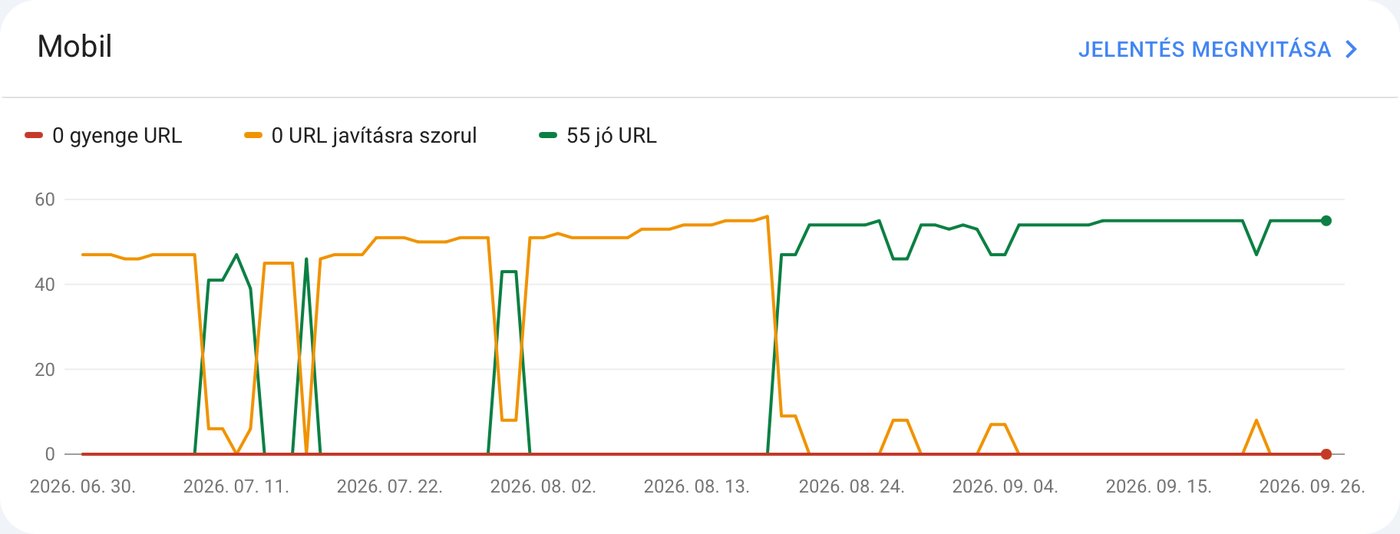
We removed the homepage slider, a typical cause of poor Largest Contentful Paint (LCP), and fine-tuned the W3 Total Cache configuration. The result shows in field data from real users: since the second half of August almost all mobile URLs have been rated "good" in the Core Web Vitals report (at most 8 URLs slipped back on a few days), and today all 55 are. Before, most of them needed improvement.
On-page SEO and information architecture
Using Yoast SEO, every page, post and image received a focus keyword, title, meta description and alt text, one by one. We rebuilt the site structure around the search intents clustered around "Budapest massage": each treatment got its own clearly targeted subpage, and we created a separate Prices page for transactional searches. Blog posts were brought to a consistent heading hierarchy and structure.
Conversion-focused UX
We made the homepage problem-focused: visitors start from their own complaint ("Back, lower-back or neck pain?") and are guided to the right treatment. Calls to action got a more prominent, clearly distinct button design. At the Dunakeszi salon we introduced the Salonic online booking system and rebuilt the booking page, so an appointment request can be completed in a few steps.
Local SEO and reputation
We displayed the salon's Google reviews on the website and actively encouraged guests to review it on its Google Business Profile. Fresh, genuine reviews matter for both local rankings and conversion.
Measurement
We track clicks, impressions, indexing and Core Web Vitals continuously in Google Search Console. The figures below come from there.
The results
Before the takeover (9 December 2025 – 28 February 2026) the site appeared in Google web search an average of 656 times a day and received 22.8 clicks. Over the last 90 days (29 June – 26 September) that is 972 impressions (+48%) and 26.8 clicks (+18%) a day. Growth has picked up in recent months: compared with the 90 days before, daily impressions rose 36% and daily clicks 10%, and in September the average was already 28.4 clicks a day.
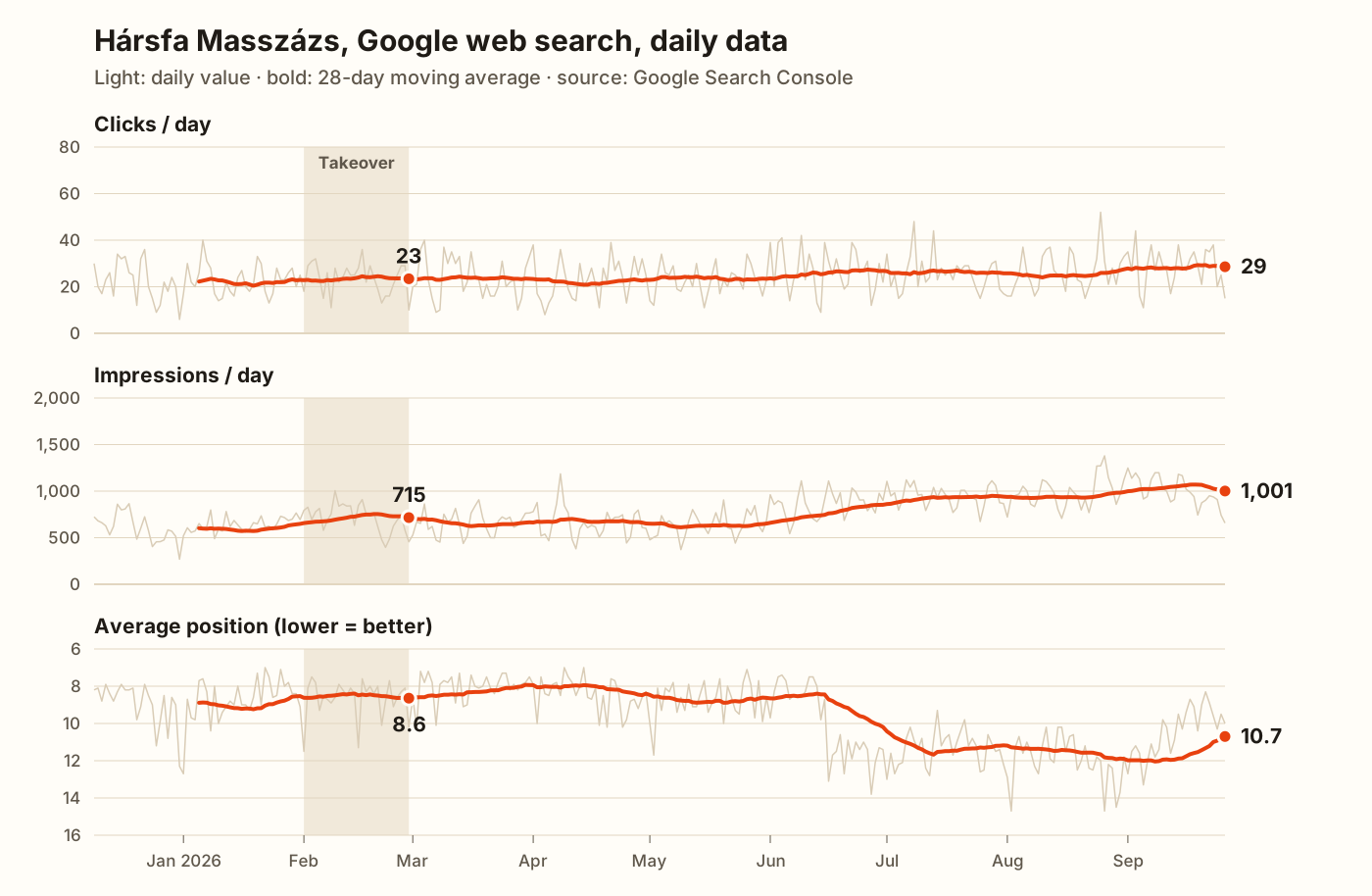
According to Google's milestones, 28-day clicks reached 600 in January (before we took over), 700 in June and 800 on 18 September.
Notes on methodology:
- We compare daily averages because Search Console holds data from 9 December 2025, so the period before the takeover is shorter than the time since. The pre-takeover period also includes the winter holidays, when searches are typically lower.
- Average position moved from 8.7 to 11.3 and average CTR from 3.5% to 2.8% (pre-takeover period vs. the last 90 days). This is a typical side effect of expanding visibility: both are impression-weighted averages, and most of the extra impressions since June come from new, more competitive queries where the site doesn't rank at the top yet. These pull the averages down while clicks have grown. In September the average position already started to improve.
- Organic traffic also depends on seasonal and algorithmic factors, so the figures reflect the combined effect of the whole project, not the impact of any single step.
The takeaway
The salon didn't need a new website. It needed sound technical foundations, a well-planned information architecture, fast loading, secure operation, a clear booking path and proper measurement, and within six months the salon was appearing in Google one and a half times as often, bringing in more and more visitors. If your site works but doesn't bring in customers, let's look at it together and see what can be improved.